





Foundation Cracks: What Homeowners Need To Know Before Paying $30,000 For A Problem That May Cost $300
Every year, tens of thousands of American homeowners are talked into five-figure foundation repairs they didn't need. The reason is simple — and it has almost nothing to do with the crack on your basement wall.
Dave Chen
Home Safety Reporter
Published April 22, 2026
9 min read · Verified by licensed structural engineer
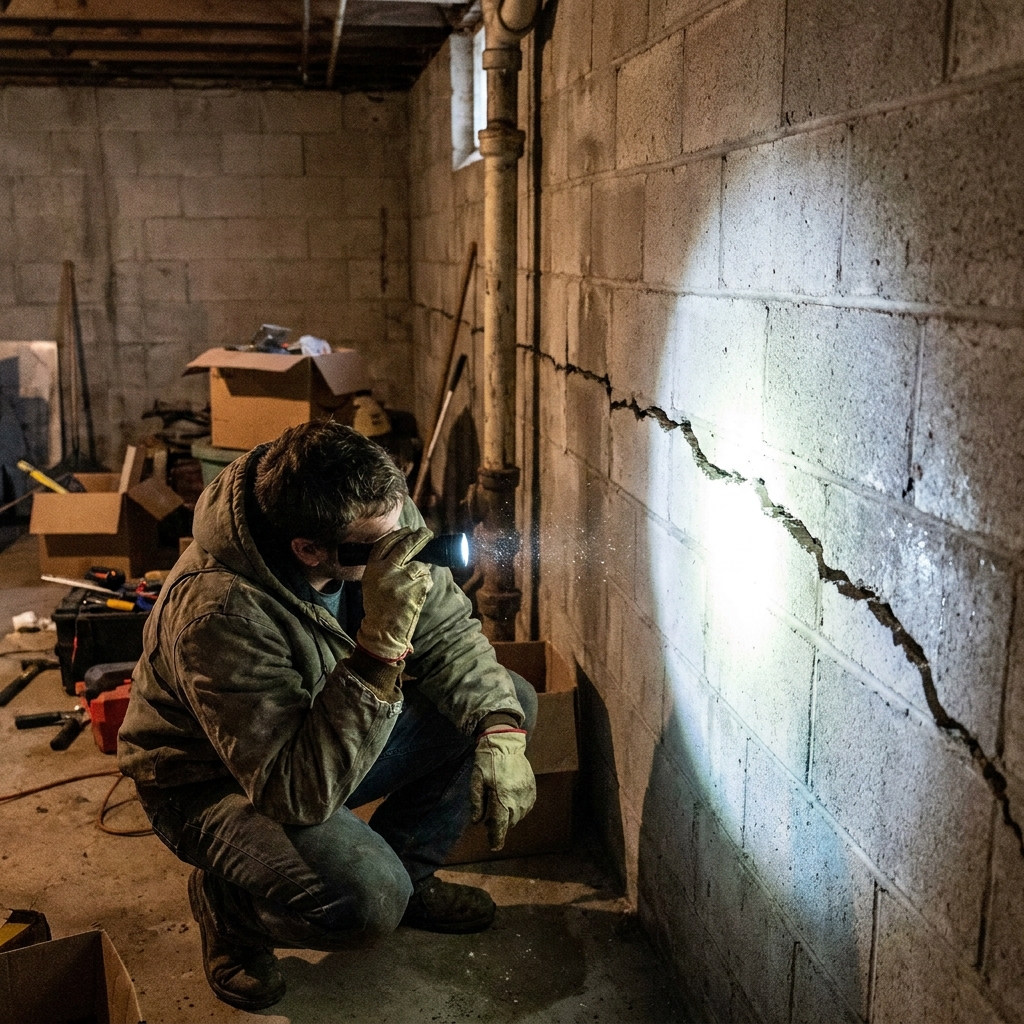
A homeowner inspects a vertical crack in a poured concrete basement wall. Not every crack is a structural problem — but contractors often quote them as if they were.
The call usually starts the same way. A homeowner notices a crack — maybe it's been there for years, maybe it appeared after a heavy rain — and they book a "free inspection" with the company whose truck they saw in the neighborhood. Within 45 minutes, a salesman in a polo shirt is standing in their basement explaining that their house is, essentially, in the process of falling down. The quote? Anywhere from $15,000 to $30,000. The financing? Conveniently available on the spot.
Here is what that salesman almost never tells you: according to the American Society of Home Inspectors, the majority of foundation cracks in residential homes are cosmetic. They are the normal result of concrete curing, seasonal soil movement, and minor settling — and they can often be sealed for a few hundred dollars by a qualified waterproofing contractor, or sometimes monitored with no repair at all.
The problem is that most "foundation repair companies" are not engineering firms. They are sales organizations. Their representatives are trained in objection handling, urgency scripts, and high-ticket closing — not structural engineering. And they have one product to sell: an expensive repair.
Not Sure If Your Crack Is Serious? Talk To Someone First.
Free homeowner helpline. No contractor dispatched. No sales pitch. Just information.
Call Free: (833) 400-0002The Crack That Costs $300 vs. The One That Costs $30,000
Before you let anyone into your basement with a clipboard, you need to understand what you are actually looking at. Foundation cracks fall into two broad categories, and the difference between them is usually visible to the naked eye.
The cosmetic crack. A thin, vertical crack — typically less than 1/8 inch wide — that runs roughly straight up and down on a poured concrete wall is almost always a shrinkage crack. Concrete shrinks as it cures, and it continues to move slightly with temperature and humidity for the life of the house. These hairline vertical cracks are the plumbing equivalent of a minor drip: worth sealing to prevent water intrusion, but not a structural emergency. Cost to properly seal with a polyurethane or epoxy injection: typically $300 to $800.
The crack you should worry about. A horizontal crack that runs sideways across the wall is a different animal entirely. Horizontal cracks usually indicate lateral pressure from saturated soil pushing against the foundation — a condition that, left unaddressed, can cause the wall to bow, shift, or in rare cases fail. Stair-step cracks in a concrete block foundation, especially ones wider at the top than the bottom, often signal differential settling, meaning one part of the house is sinking faster than another. Any crack wider than 1/4 inch, or any crack where the two sides are no longer flush — where you can feel a ledge running your finger across it — deserves a look from a structural engineer.
The single most useful piece of information a homeowner can have is this: direction, width, and displacement. Vertical and thin, with no offset? Almost certainly cosmetic. Horizontal, stair-stepped, or displaced? That is the conversation where engineering actually matters.
Send Us A Photo — We'll Tell You What You're Looking At
Free 10-minute phone consult. No obligation. No repair company referral unless you ask.
Call Free: (833) 400-00025 Foundation Warning Signs You Should Never Ignore
Not every crack is an emergency. But a handful of symptoms mean you should stop reading and get on the phone — with an engineer, not a salesman.
- Horizontal cracks in a basement wall.
If the crack runs sideways — especially across the middle third of the wall — the soil outside your foundation is pushing harder than the wall was designed to resist. This is the single most common precursor to foundation wall failure. Horizontal cracks do not get better on their own, and they should never be ignored or painted over.
- A wall that is visibly bowing or leaning.
Hold a long level or a piece of straight conduit against the wall. If the wall curves inward more than roughly an inch across its height, it is actively deforming. Bowing walls are a structural issue regardless of what any salesman tries to upsell around them — but the fix is engineered, not estimated by sight.
- Stair-step cracks in block or brick foundations.
A jagged crack that climbs diagonally up the mortar joints of a block wall — following the stair pattern of the blocks — is typically caused by differential settlement. It means one part of your foundation is moving independently of another. Small, stable stair-steps can sometimes be monitored. Active, widening ones are a real problem.
- Doors and windows on upper floors that suddenly stick.
Foundations do not exist in isolation. If a second-floor door that swung freely last year now drags on its frame, or a window that always opened now refuses, the house itself may be shifting above a moving foundation. This is a clue that works in conjunction with visible cracks — not a reason to panic on its own.
- Water entering through a crack, every time it rains.
Even a cosmetic crack becomes a serious problem when it channels water into the structure. Persistent moisture behind drywall or inside wall cavities is the starting condition for toxic mold — a secondary hazard most homeowners never anticipate when they are thinking about foundation repair. If your crack is leaking, the crack and the moisture have to be addressed together.
Any one of these warrants an independent assessment. None of them, on their own, justify signing a $25,000 contract in your basement on a Saturday afternoon.
Seeing Any Of These 5 Signs In Your Home?
Call the free helpline before you schedule an in-home 'inspection.' It takes 10 minutes.
Call Free: (833) 400-0002How Foundation Contractors Inflate Repair Quotes
After speaking with dozens of homeowners, licensed engineers, and former foundation salespeople for this piece, a pattern emerges. It is not that every foundation company is dishonest. It is that the industry's incentive structure almost guarantees inflated recommendations.
Foundation repair salespeople are typically paid on commission. The bigger the job, the bigger the check. A representative who quotes a $600 crack injection makes a fraction of what a representative who sells a $22,000 pier system makes — even if, from an engineering standpoint, the crack injection was the correct solution. That misalignment alone explains a remarkable amount of what happens at the kitchen table.
The tactics are consistent from market to market. A "free inspection" becomes a fear-based walkthrough: flashlight to the crack, serious tone, phrases like "I wouldn't want my family sleeping over this," "I've seen walls go in Denver for less than this," or "I'll be honest with you — this is a bad one." The homeowner, now alarmed, is shown a glossy brochure with cutaway illustrations of pier systems, carbon fiber straps, or full wall replacements. Then comes the price — always high — followed by a same-day discount if they sign today.
Several former sales reps we spoke with described explicit company policies: never leave the house without a signed contract, always pitch the premium option first, and if the homeowner hesitates, reduce the price by an arbitrary amount to simulate a deal. One former employee of a regional chain told us, bluntly: "We weren't trained on foundations. We were trained on closes."
The result is that a homeowner with an ordinary vertical shrinkage crack can easily receive a $24,000 quote — financed, of course, through a partner lender — for a "helical pier stabilization system" that their foundation does not need and an engineer would never recommend.
Already Got A Quote Over $10,000? Get A Second Opinion First.
Free review of your existing quote by phone. We'll tell you what's standard and what's upsell.
Call Free: (833) 400-0002What A Legitimate Foundation Assessment Must Include
A real structural assessment looks almost nothing like a sales visit. If the company showing up at your door checks even three of the boxes below, you are probably in good hands. If it checks none of them, you are being sold to.
The independent assessment checklist:
- 1. A licensed structural engineer — not the repair company. The person evaluating your foundation should have a Professional Engineer (PE) license and no financial interest in the repair recommendation. Most reputable engineers charge $350 to $700 for a residential foundation evaluation. That fee is the single best money a homeowner in doubt can spend.
- 2. A soil condition check. Foundation movement is almost always driven by what is happening in the soil — expansion, saturation, poor drainage, compaction issues. A real assessment considers soil type and drainage at the site, not just the visible crack.
- 3. A written report with findings and recommendations. The engineer's deliverable should be a signed document describing what they observed, what they believe is causing it, whether it is active or stable, and what — if anything — needs to be done. This report is what you show to contractors for bidding.
- 4. Multiple, independent quotes using the engineer's report. Once you have the report, you solicit at least three bids from repair contractors based on the engineer's specified scope. This flips the dynamic: instead of letting a salesperson define the problem and the solution, the engineer has already defined both, and the contractors are competing on price and quality of work.
- 5. No same-day financing pressure. A legitimate structural problem that has existed for months or years does not need to be signed for on Tuesday evening. Any contractor insisting otherwise is selling, not diagnosing.
Homeowners who follow this process routinely discover that a quoted $20,000 repair was actually a $1,500 crack injection plus an exterior drainage correction — or, in many cases, no repair at all, just monitoring. The engineer's fee pays for itself many times over.
If you are staring at a crack right now, or holding a quote that feels too high, the simplest first step is to talk to someone who is not trying to sell you a pier system. Our free helpline exists for exactly that conversation. A call takes about ten minutes, and most callers get off the phone with a much clearer picture of whether they actually have a structural issue, a cosmetic one, or a water-intrusion problem dressed up as foundation failure.
Before You Sign Anything — Talk To Us First.
Free homeowner helpline. No contractor dispatched. No pressure. Just a real conversation about what you're actually looking at.
Call Free: (833) 400-0002A Final Note On Water And Mold
One piece of this story almost always gets missed. When a foundation crack leaks — even a minor one — water enters the wall system. That moisture does not stay in the concrete. It wicks into framing, insulation, and drywall, and within weeks it can create the exact conditions required for mold growth. Homeowners who spend $20,000 "fixing" their foundation and never address the moisture path often end up with a second, more expensive problem inside their walls twelve months later.
If your crack is wet, the right order of operations is: diagnose the structural question, address any required repair, and then correct the water path — drainage, grading, gutters, or interior waterproofing — before the drywall goes back up. Skipping any of those steps costs more money, not less.
This article was reported and written by Dave Chen, Home Safety Reporter, and reviewed by a licensed structural engineer prior to publication. HomeownerAffairs does not perform foundation repairs and has no financial relationship with any repair contractor. The free homeowner helpline provides general information only and is not a substitute for a professional engineering assessment.
Reader Comments (412)
Sorted by most helpful“Wish I had read this last year. Paid $26,000 for helical piers on the front corner of my house because a salesman convinced me the whole foundation was 'going.' A year later, a neighbor's engineer told me the actual issue was a clogged downspout on the same corner — $80 of gutter work would have handled it. The piers were not wrong exactly but they were dramatic overkill. Get the engineer first. Please.”
“I called the helpline on this article after I found a horizontal crack in the basement — the scary kind the article describes. The person on the phone was calm, asked me a bunch of questions, and told me to photograph it and hire a PE before doing anything else. Turns out I did need real work done, but the engineer's scope came back at about a third of what the first repair company quoted me. Saved me at least $14,000 on a problem that was real.”
“Retired contractor here. I have watched this industry change over twenty years and it is worse now than it has ever been. Most of the guys knocking on doors are trained closers, not builders. When I bought my own home I had an engineer out before I let a single foundation company past the driveway. Cost me $425 and completely changed the conversation. This article is exactly right — get the independent opinion first, always.”
“I had two different foundation companies quote me $18,400 and $22,900 for 'wall stabilization' after I called about a crack in my basement. Both were at my house within 48 hours and both tried to close me that day. I finally paid $500 for a structural engineer to come out and he spent twenty minutes looking at it before telling me it was a standard shrinkage crack and to seal it with epoxy. The seal cost me $380. I came within a signature of spending twenty grand I did not need to spend.”