





The HVAC Mold Problem No Technician Will Tell You About — And Why Your Air Could Be Making You Sick Right Now
Every time your air conditioner runs, it pumps conditioned air through the same ductwork that may be silently distributing mold spores to every room in your house. This is not a rare problem. It is one of the most common — and most preventable — indoor air quality failures in American homes.
Sandra Abrams
Home Air Quality Reporter
Published April 22, 2026
8 min read · Reviewed by certified HVAC inspector
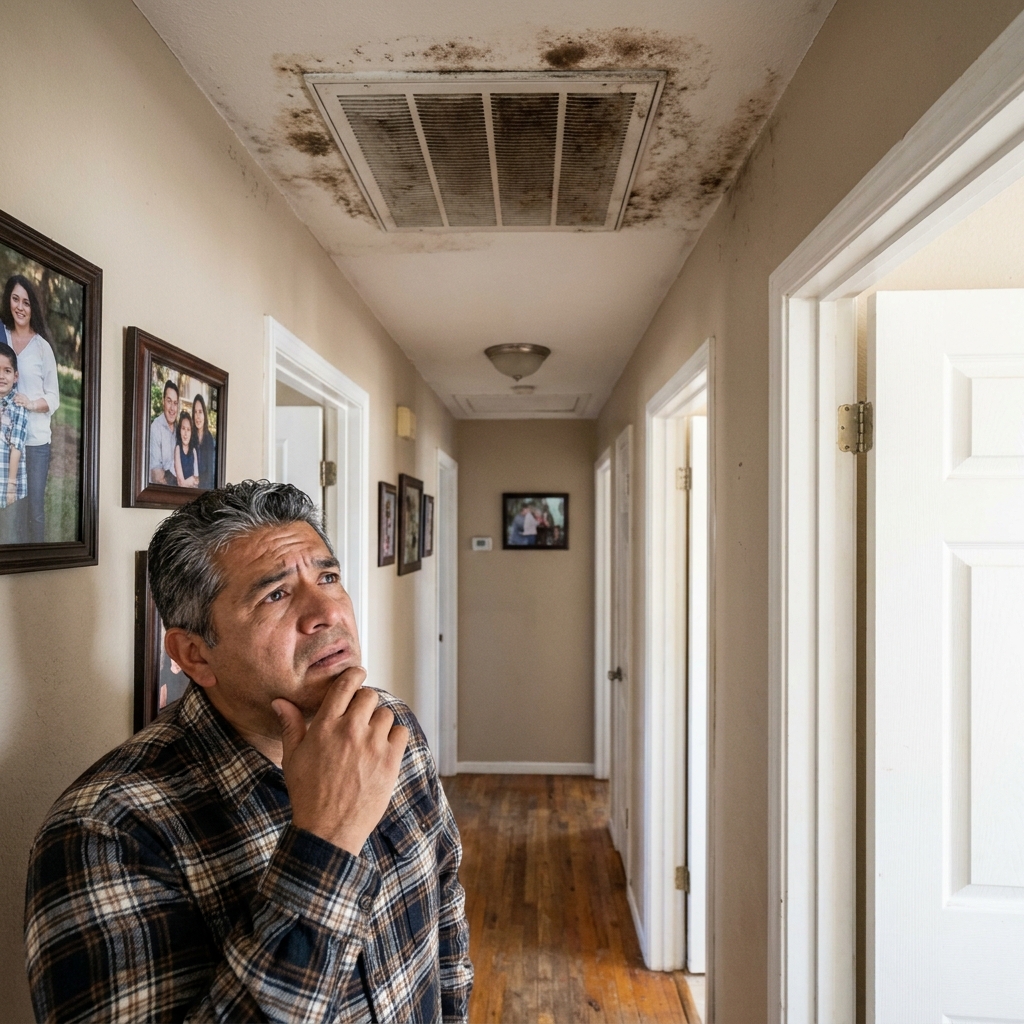
Dark discoloration around a ceiling vent is the most visible sign of a mold problem inside your ductwork — but by the time you can see it, the spores have already been circulating for months.
The evaporator coil inside your air handler sits in a cold, dark, perpetually damp environment — the exact conditions mold requires to grow. Every drop of humidity in your home's air condenses on that coil as the system runs. In a properly maintained system, that condensate drains away cleanly. In the roughly 60 percent of systems that haven't been serviced in over two years, it pools in the drain pan, saturates the coil, and begins feeding a colony of mold that the system then distributes to every room, every hour it runs.
Most HVAC technicians know this. The ones doing routine tune-ups — $79 to $149 specials, typically offered in September and March — often find mold contamination on the coils and in the drain pan within the first five minutes of pulling an access panel. A large percentage say nothing, because the conversation that follows is expensive and complicated: coil cleaning is a labor-intensive two-to-three hour job, duct remediation is a separate contractor, and many homeowners balk at the total figure. It's easier to change the filter, run a few diagnostics, and move on to the next call.
This is the gap that makes HVAC mold one of the most underdiagnosed indoor air problems in the country. You cannot see it. You cannot smell it in most cases — the smell that homeowners describe as "musty when the AC kicks on" is actually a late-stage indicator after heavy contamination has already set in. And your system is running continuously, which means whatever is growing on that coil is being delivered to your family's lungs all day, every day, all summer long.
Concerned About What's in Your HVAC System?
Free homeowner helpline. No HVAC company dispatched. No upsell. Just information about what to ask and who to call.
Call Free: (833) 400-0002The Biology of HVAC Mold: Why Your Air Conditioner Is a Perfect Incubator
The evaporator coil in your central air conditioning system operates at between 35°F and 50°F during a cooling cycle. The air passing over it is warm and humid. Basic thermodynamics means water vapor in that air condenses on the coil's metal surface — this is how your air conditioner dehumidifies your home. The problem is that condensate doesn't just drip cleanly off a coil and into a drain pan. It clings to the coil fins, to the coil housing, to the edges of the air handler cabinet, and to the insulation lining the inside of the unit. The surfaces stay wet between cycles. Organic material — dust, skin cells, pet dander — accumulates on those same wet surfaces.
Mold spores are in every home's air at all times. Under normal conditions, they are inert — they land on surfaces, find nothing to eat, and nothing happens. The evaporator coil gives those spores everything they need: constant moisture, darkness, moderate temperatures, and an organic food source. Growth can begin within 24 to 48 hours on a contaminated surface. Within weeks, an established colony will be releasing spores directly into the airstream that your system then distributes throughout every room connected to the ductwork.
The most common species found in residential HVAC systems are Cladosporium, Penicillium, Aspergillus, and — in systems with standing water in the drain pan — Stachybotrys, the species colloquially known as "black mold." The health effects range from mild (runny nose, eye irritation, elevated allergy symptoms) to serious (chronic sinus infections, asthma onset or worsening, respiratory illness in immunocompromised individuals, and in the case of certain Aspergillus and Stachybotrys species, more severe systemic effects).
Has Someone in Your Home Had Unexplained Allergy or Respiratory Symptoms?
HVAC mold is one of the top three causes. Call the free helpline — we'll help you figure out whether to test or inspect first.
Call Free: (833) 400-00025 Warning Signs Your HVAC System Has a Mold Problem
None of these alone confirm mold contamination. But any two or three together should prompt a professional inspection before you run your system another season.
- A musty or earthy smell when the system first turns on.
This is the smell of mold spores and mycotoxins entering the airstream. It is most noticeable in the first 30 to 90 seconds of a cycle, before the volume of conditioned air dilutes the concentration. If the smell fades after five minutes but returns at the start of the next cycle, the source is almost certainly the coil, the drain pan, or the first few feet of supply ductwork directly downstream of the air handler.
- Dark staining or discoloration around supply vents.
The dark ring you see on the ceiling around an HVAC register is a visible biofilm — mold and dust particles being deposited on the painted surface as air accelerates out of the vent. By the time you can see this with the naked eye, the mold colony producing those particles has been established for months. This is not a cosmetic issue. It is a sign of active, ongoing contamination of your living space.
- Allergy or respiratory symptoms that are worse at home than outdoors.
The conventional wisdom is that indoor air is "safer" than outdoor air. For a home with HVAC mold contamination, the opposite is true. If someone in your household has symptoms that improve when they travel, that worsen in summer when the AC runs constantly, or that improve when windows are open and the system is off, the indoor air supply is a primary suspect. This pattern is frequently misattributed to "seasonal allergies" when the source is actually the air conditioning system.
- Standing water or rust staining in the drain pan under the coil.
The condensate drain pan should drain completely between cycles. If there is standing water in the pan — visible when you remove the air handler access panel — the drain line is either partially clogged or the pan is not properly pitched. Standing water means the coil is sitting in a puddle during off-cycles. This condition alone is sufficient to develop significant mold growth within two to three weeks. Rust staining around the edges of the pan is evidence that standing water is a recurring, not a one-time, event.
- An HVAC filter that turns black within two to four weeks of being changed.
A filter that goes from white to heavily soiled in less than a month is not just capturing normal household dust — it is capturing mold spores at a rate that indicates active contamination upstream of the filter. Standard 1-inch filters do not remove mold spores efficiently even when clean; a heavily loaded filter that is partially bypassed at the edges is doing essentially nothing to protect air quality. A filter that needs monthly replacement is a system that needs professional inspection.
Seeing Any of These Signs in Your Home?
Call before you book a tune-up. The helpline will help you understand what kind of inspection you actually need.
Call Free: (833) 400-0002Why Your HVAC Technician Probably Won't Bring It Up
The economics of the HVAC service industry almost guarantee that mold contamination will be underreported. The average residential tune-up call is priced at $89 to $149. The technician performing it is often paid on a combination of hourly wage and upsell commission. The work that follows a mold finding is expensive and slow: coil cleaning alone is $400 to $800 and takes two to three hours of careful chemical treatment, rinsing, and re-inspection. Duct remediation, if the contamination has spread into the ductwork, starts at $1,200 and can run to $4,000 for a mid-size home. Neither of those jobs is something a tune-up tech typically performs — they require a different crew, different equipment, and a separate quote process.
The easiest path for the technician is to note "coils slightly dirty, recommend cleaning" on the service form and move on. Many homeowners never follow up. The technician makes his flat rate, avoids the awkward conversation, and the mold colony continues to grow.
The situation is made worse by the structure of HVAC maintenance agreements. Many companies sell $150-per-year "maintenance plans" that include two tune-ups. The marketing implies comprehensive system care. The reality is that coil cleaning is almost always excluded from the plan — it is an "add-on" quoted separately, and the add-on is where the real money is. Homeowners who believe they are "having the system professionally maintained" are often getting a filter change and a thermostat calibration, with the coil problem sitting untouched behind an access panel the technician never opened.
Have a Maintenance Plan and Still Smell Mustiness?
Your plan almost certainly doesn't include coil cleaning. Free call to understand what you're actually paying for.
Call Free: (833) 400-0002What a Real HVAC Air Quality Inspection Must Include
A legitimate HVAC mold inspection looks nothing like a standard tune-up. If a contractor shows up with a shop vac and a filter, they are not doing an air quality inspection. Here is what an honest inspection requires.
The HVAC air quality inspection checklist:
- 1. Visual inspection of the evaporator coil with access panel removed. The coil should be photographed and shown to the homeowner. Any dark discoloration, slime, or visible growth on the coil fins is mold or bacterial biofilm and requires chemical treatment.
- 2. Drain pan inspection and drain line flush. The pan should be dry or draining freely. A clogged drain line is treated with a biocide solution followed by a clear-water flush until drainage is confirmed at the outdoor drain point.
- 3. Coil cleaning with EPA-registered antimicrobial coil cleaner. Not a light spray — a proper coil cleaning involves a foaming coil cleaner applied under pressure, allowed to dwell for 10 to 15 minutes, and rinsed thoroughly. The technician should be able to show you the run-off color and confirm it runs clear before reassembly.
- 4. Air sample or surface swab for mold species identification. If visible growth is found, a sample should be taken and sent to a lab to identify the species. Not all mold is equal — Stachybotrys requires a different response protocol than Cladosporium, and knowing the species determines whether duct remediation is also needed.
- 5. Duct inspection for downstream contamination. If the coil has had established mold growth, spores have been entering the ductwork for weeks or months. A fiber-optic camera inspection of the first 10 to 15 feet of supply ductwork will confirm whether the contamination has spread beyond the air handler.
- 6. Written report with photographs. The inspection should end with a document you can keep, show to your insurance company, or hand to a second contractor for comparison. A verbal "it was a little dirty" is not documentation.
If you are not sure whether the contractor you are calling does this kind of thorough inspection — or if you are not sure whether you have a mold problem at all — the free helpline below is the right first call. The people who answer do not sell HVAC services and do not benefit from what you ultimately decide to do. Their job is to help you understand what is actually going on in your system.
Call the Free Helpline Before You Book Anything.
10-minute call. No contractor dispatched. We help you ask the right questions and avoid paying for the wrong service.
Call Free: (833) 400-0002This article was reported by Sandra Abrams, Home Air Quality Reporter, and reviewed by a certified HVAC inspector prior to publication. HomeownerAffairs does not perform HVAC services and has no financial relationship with any contractor. The free homeowner helpline provides general information only and is not a substitute for a professional inspection.
Reader Comments (318)
Sorted by most helpful“Former HVAC technician here, 8 years in the field. This article is accurate. The dirty coil conversation is uncomfortable because it ends in one of two ways: the homeowner pays $500+ to clean it, or they decide to replace the whole system for $6,000-$10,000 because 'it's old anyway.' Either way, the tune-up tech doesn't do the work — he just generated a lead that goes to a more senior salesman. The honest thing is to always tell the customer what you find. A lot of companies have an unwritten culture of only mentioning things you can close on the same visit.”
“We live in Phoenix. Our AC runs from April through October — basically non-stop for seven months. I called the number on this page after noticing the smell the article describes, that musty hit when the system first kicks on. The person I spoke with asked me a series of specific questions and told me I almost certainly had a drain pan and coil issue given our climate and usage hours. She explained what a proper cleaning should include and what questions to ask any contractor. I ended up getting three quotes. The lowest was $380, the highest was $1,100. The middle one explained every step and showed me photos after. The smell is completely gone.”
“I'm an allergist. The number of patients I see who have been through the full allergy workup — skin testing, bloodwork, immunotherapy consultations — without anyone ever asking about their HVAC system is remarkable. Indoor mold from HVAC contamination is one of the most common sources of year-round allergic rhinitis and asthma in the Southeast. I now routinely ask patients whether their AC has been professionally inspected in the past 24 months, and I recommend the same basic steps this article describes: pull the panel, inspect the coil, check the drain. It is the simplest test most of my patients have never been offered.”
“I had the same HVAC company doing a maintenance plan for three years — two visits a year, $150 annually. Never once did they open the air handler panel. I finally had a different company out after my son's asthma got noticeably worse every summer. They pulled the panel and photographed the coil. It looked like the inside of a cave. The drain pan had an inch of standing water with visible black growth on the sides. I asked the new tech why the other company never caught this. He said, quote, 'Because they'd have to charge you to fix it.' We spent $650 getting the coil properly cleaned and the drain line cleared. My son's summer symptoms have improved significantly.”